

If you’re running a business in 2026 and haven’t decided between Claude vs ChatGPT vs Gemini, you’re not alone. The AI assistant market has matured fast, and all three platforms now offer serious capabilities that go well beyond generating a quick email draft. The real question isn’t which one is “best” — it’s which one solves your specific problems.
Whether you’re a startup founder building your first product, a mid-size company streamlining operations, or an enterprise team evaluating AI for software development, the platform you choose will directly impact how fast you ship, how well you communicate, and how efficiently you operate. This comparison breaks it down without the hype.
What Are Claude, ChatGPT, and Gemini?
Before diving into the comparison, here’s what each platform actually is.
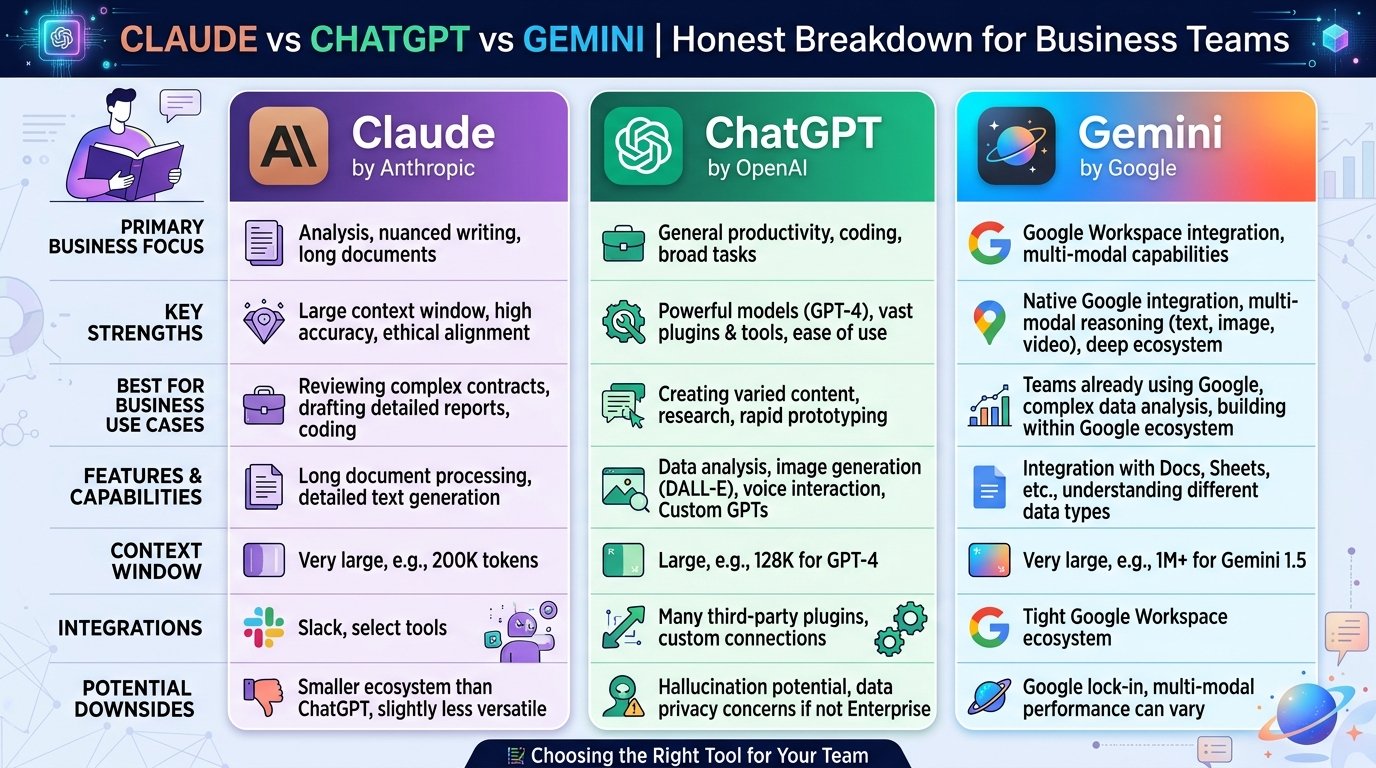
ChatGPT is OpenAI’s flagship AI assistant, currently powered by GPT-5. It’s the most widely adopted AI platform globally, with hundreds of millions of weekly active users. It excels at general-purpose tasks and has the most mature plugin and integration ecosystem.
Claude is Anthropic’s AI assistant, currently running Claude 4.6 (with Opus 4.7 recently released). It’s known for deep reasoning, long-context processing, and particularly strong performance in coding and structured analysis. Developers and technical teams tend to gravitate toward Claude for complex, reliability-critical work.
Gemini is Google’s AI platform, tightly integrated with Google Workspace. Its standout feature is multimodal capability — it handles images, video, and audio natively — and it offers the largest context window in the market. If your business already runs on Google’s ecosystem, Gemini feels like a natural extension.
Each serves a different niche, and understanding those differences is what separates a smart AI investment from a wasted subscription.
Why Choosing the Right AI Platform Matters for Your Business
This isn’t a trivial decision. According to recent enterprise surveys, businesses using the wrong AI tool for their workflow spend an average of 30% more time correcting outputs than those who’ve matched the tool to the task. That’s real money.
Consider this: a US-based SaaS startup using ChatGPT for complex code refactoring might get decent results, but the same team using Claude could see significantly fewer hallucinations and cleaner architectural suggestions. Conversely, a marketing agency that lives inside Google Docs and Gmail would find Gemini’s native integration far more productive than switching between separate tools.
The platform you choose affects three critical areas: output quality, workflow integration, and total cost of ownership. If you’re in the process of building an AI-powered application, these factors become even more consequential because the model behind your product determines its ceiling.
Claude vs ChatGPT vs Gemini: Head-to-Head Comparison
Coding and Software Development
For development teams, this is where the differences become stark. Claude 4.6 consistently leads coding benchmarks in 2026, including SWE-bench and Terminal-Bench evaluations. It handles full-file refactors, understands architectural patterns across large codebases, and produces cleaner code with fewer hallucinations than its competitors.
ChatGPT remains the most versatile option — it knows virtually every framework and library, and its Code Interpreter is excellent for data analysis tasks. But for deep logic problems and multi-file synthesis, Claude has an edge.
Gemini performs well for Google ecosystem development (Firebase, Android, Google Cloud) and its speed is noticeably faster. However, consistency can be an issue — it occasionally produces different answers to the same prompt.
If your team is evaluating mobile development frameworks like Flutter vs React Native, or weighing Java vs Python for a backend project, pairing the right AI assistant with the right language stack can meaningfully accelerate delivery.
Writing, Research, and Content
ChatGPT has long been the default for content generation, and GPT-5 has improved considerably over earlier versions. It’s conversational, creative, and handles a wide range of writing styles well.
Claude produces more nuanced, analytically rigorous content. It’s particularly strong when you need structured outputs — think technical documentation, long-form analysis, or detailed reports. If you’re modernizing a legacy software product and need thorough documentation, Claude handles that depth well.
Gemini’s strength in research comes from its deep web integration. It pulls real-time information naturally and excels at synthesizing data from multiple sources. For teams doing market research or competitive analysis, this is genuinely useful.
Context Window and Long-Document Processing
This is where technical specifications matter. Claude Opus offers up to one million tokens of context, meaning it can process entire codebases or dozens of 100-page documents in a single prompt. Gemini matches or exceeds this with up to two million tokens, though quality can degrade at the upper end. ChatGPT’s GPT-5 offers approximately 128K to 1M tokens depending on the tier.
For businesses dealing with large datasets, lengthy contracts, or complex data architecture strategies, context window size directly affects how useful the AI actually is in practice.
Pricing
At the consumer level, all three charge roughly $20/month for their pro tiers. The real cost differences emerge at the API and enterprise level. Gemini Flash is the cheapest for API usage. Claude Sonnet offers a strong middle ground between cost and capability. ChatGPT’s Team plan at $25/user/month is straightforward for organizations already committed to the OpenAI ecosystem.
Integration and Ecosystem
ChatGPT has the most mature plugin marketplace and third-party integrations. Gemini is unbeatable if you’re already in Google Workspace. Claude’s enterprise integrations are growing rapidly, particularly through Amazon Web Services (backed by Amazon’s investment in Anthropic).
For businesses managing e-commerce platforms optimized for peak seasons or running complex financial risk management software, the integration story matters as much as raw capability.
Real-World Use Cases: Which AI for Which Job?
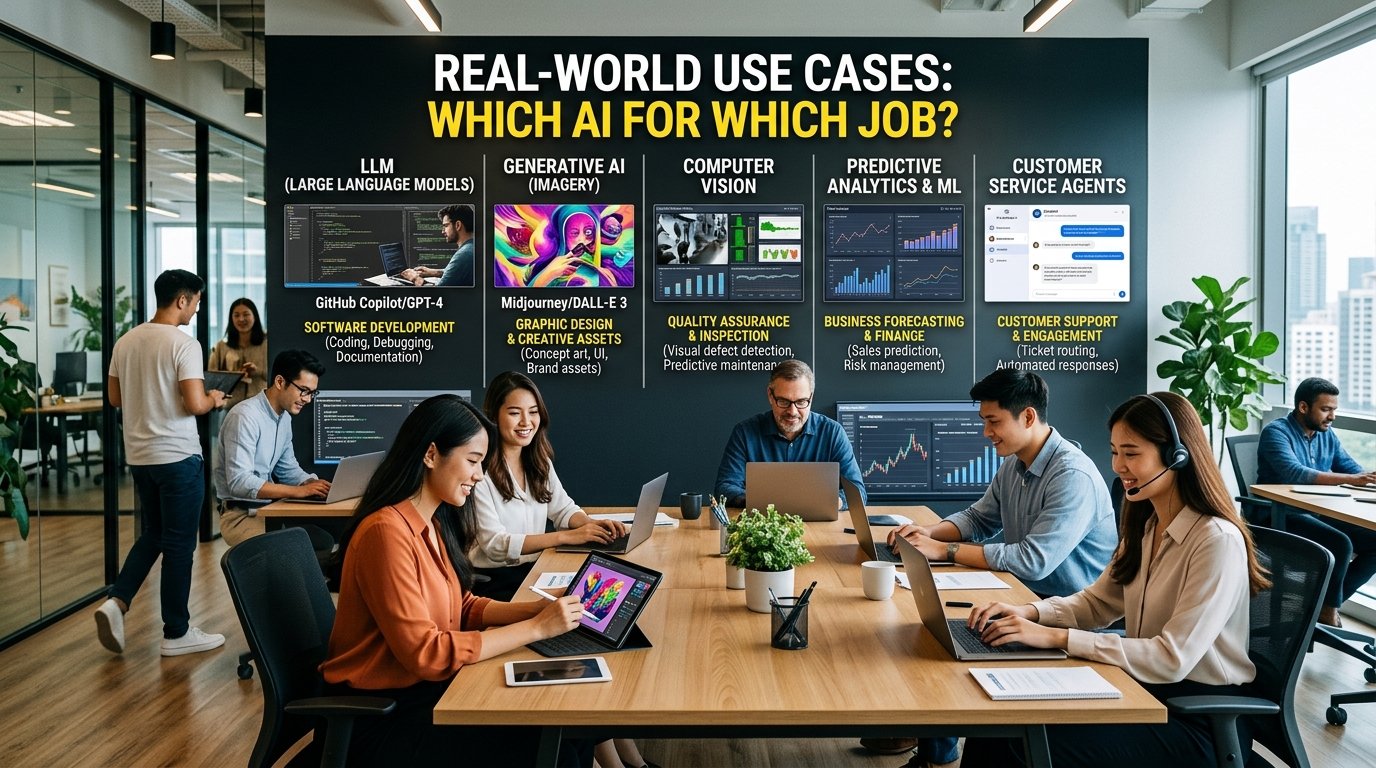
Here’s a practical breakdown of common business scenarios:
You’re building a SaaS product and need an AI coding partner. Claude is the strongest choice. Its deep reasoning and large context window let it understand your full codebase and make coherent suggestions across files. If you’re working with plugin development or complex WordPress configurations, Claude handles the architectural thinking well.
You’re a marketing team producing content at scale. ChatGPT remains the most productive option. It’s fast, versatile, and handles varied tones and formats without much prompt engineering. For teams also managing social media and SEO, ChatGPT’s speed-to-output ratio is hard to beat.
You’re an operations team running on Google Workspace. Gemini is the obvious choice. It reads your Drive, integrates with Gmail, and processes spreadsheets natively. No context-switching, no copy-pasting between tools.
You’re evaluating AI models for an enterprise deployment. You’ll likely use more than one. Many organizations are adopting a multi-model strategy — Claude for development and analysis, ChatGPT for general productivity, and Gemini for Google-native workflows. If your team is exploring how to build artificial intelligence into your products, testing all three against your actual workloads is the only way to make a confident decision.
Common Questions
Which AI is best for coding in 2026? Claude 4.6 leads coding benchmarks and is particularly strong for complex reasoning, large codebase analysis, and multi-file refactoring. ChatGPT is more versatile across languages and frameworks, while Gemini is fastest for Google ecosystem development.
Is ChatGPT better than Claude for business use? It depends on the business function. ChatGPT is better for general productivity, content creation, and teams that need a broad plugin ecosystem. Claude is better for technical teams, long-document analysis, and tasks where accuracy and reduced hallucination matter most.
Can I use Claude, ChatGPT, and Gemini together? Yes, and many businesses do. A multi-model strategy lets you match each AI’s strengths to specific workflows. This is increasingly common in enterprise environments.
Which AI has the largest context window? Gemini offers up to two million tokens, though quality can degrade at the upper end. Claude Opus offers up to one million tokens with more consistent quality. ChatGPT’s GPT-5 offers up to one million tokens depending on the tier.
How much do these AI platforms cost? All three offer free tiers with limited access. Pro subscriptions are approximately $20/month across all platforms. API and enterprise pricing varies — Gemini Flash is typically cheapest, Claude Sonnet offers a balanced middle ground, and ChatGPT has straightforward team pricing at $25/user/month.
Which AI is best for mobile app development? For mobile app development, Claude excels at complex logic and debugging, ChatGPT offers the broadest framework coverage, and Gemini integrates deeply with Android development tools. Your choice should align with your tech stack decision — native vs hybrid.
Making the Right Choice for Your Business
The Claude vs ChatGPT vs Gemini decision ultimately comes down to your team’s workflow, your technical requirements, and where you need the most leverage. There’s no single winner — only the right fit for your situation.
If you’re building software, Claude’s reasoning and code quality give it an edge. If you need broad productivity across a large team, ChatGPT’s ecosystem is hard to match. If Google runs your business, Gemini is the path of least resistance.
What matters most is implementation. The best AI platform in the world delivers zero value if it’s poorly integrated into your workflow, poorly prompted by your team, or solving the wrong problem entirely.
At Software System, we help businesses navigate these decisions — not just which AI to use, but how to integrate it into custom software, web applications, and mobile products that actually move the needle. If you’re evaluating AI tools for your next project, let’s talk about what makes sense for your specific needs.