

Mobile app development is no longer just about writing code for Android or iOS. Businesses now expect mobile apps to be fast, secure, scalable, user-friendly, and ready for modern technologies like AI, cloud systems, IoT, and cross-platform frameworks.That is why the demand for strong mobile app developer skills is increasing every year. Whether you are building native apps, hybrid apps, enterprise applications, or customer-facing mobile products, you need both technical skills and soft skills to succeed. In this guide, we will explain the most important app skills developers need in 2026, how web and mobile app developers are becoming more connected, and what businesses should look for when hiring mobile development talent.
What Are Mobile App Developer Skills?
Mobile app developer skills are the abilities required to design, build, test, launch, and maintain mobile applications.
These skills include programming, app architecture, UI/UX design, security, APIs, databases, performance optimization, and collaboration. Modern developers also need to understand how apps connect with cloud platforms, AI systems, third-party tools, and business workflows.
A strong developer does not only make an app “work.” They make it reliable, easy to use, secure, and ready to grow.
For businesses planning new digital products, understanding these skills is important before starting a mobile application development project. You can also explore how modern app planning works in this guide on how to build an AI app.
Why Mobile App Developer Skills Matter More Today
Mobile apps now support banking, ecommerce, healthcare, education, logistics, entertainment, communication, and internal business operations. Users expect apps to open quickly, protect their data, and feel simple from the first tap.
Poorly built apps often suffer from:
- Slow loading
- Security weaknesses
- Confusing navigation
- High uninstall rates
- Poor app store reviews
- Expensive maintenance issues
This is why companies need developers who understand more than basic coding. They need people who can think about product quality, user retention, long-term maintenance, and business value.
If an old app is becoming slow, outdated, or difficult to update, it may also be time to consider software product modernization.
Technical Skills for Mobile App Developers
1. Programming Language Knowledge
Programming is the foundation of mobile app development.
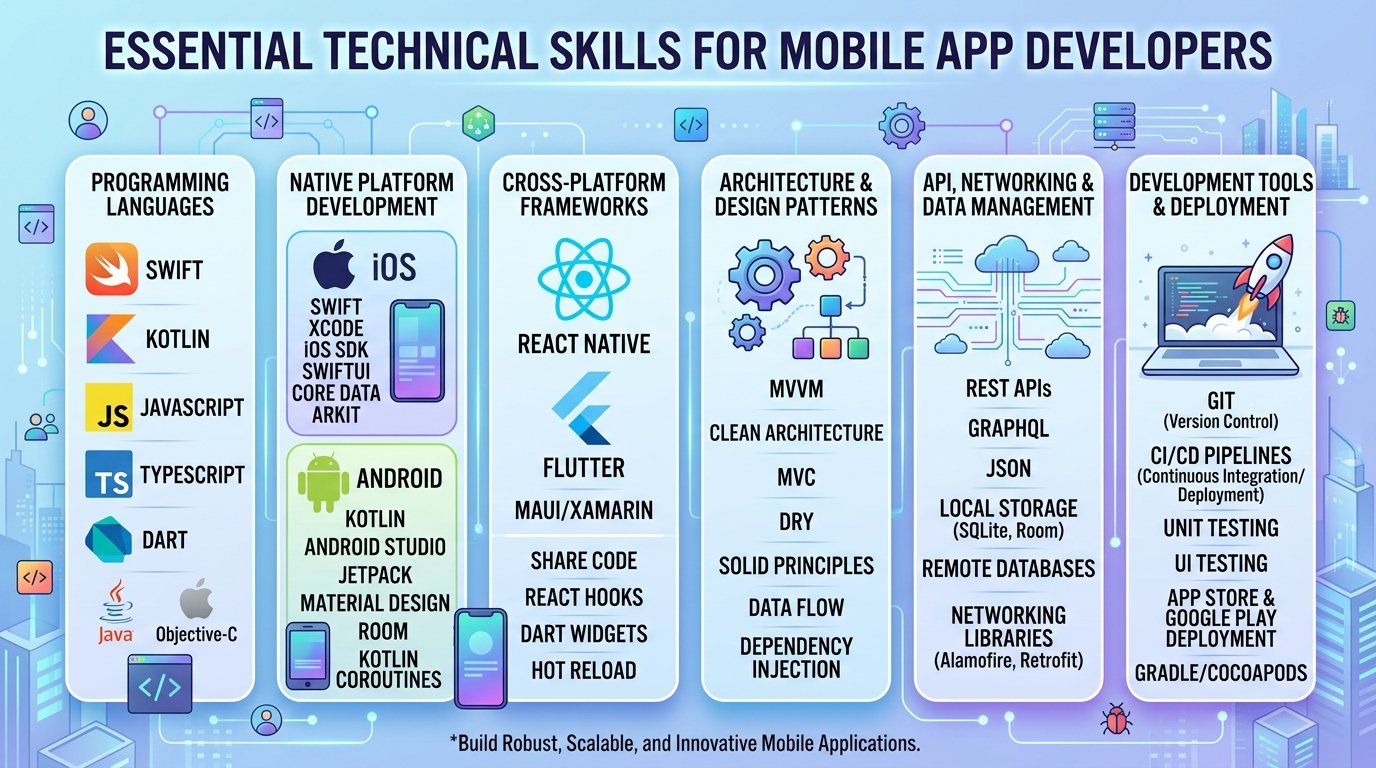
A skilled mobile developer should understand the language used for their target platform. For iOS apps, Swift is commonly used. For Android apps, Kotlin is now widely preferred. For cross-platform development, Dart and JavaScript are popular because they support frameworks like Flutter and React Native.
Important languages include:
- Swift for iOS development
- Kotlin for Android development
- Dart for Flutter apps
- JavaScript for React Native apps
- Java for Android legacy apps
- C# for Xamarin or enterprise apps
- C++ for games and performance-heavy apps
Developers do not need to master every language at once. However, understanding the right language for the right project helps teams make better technical decisions.
For iOS-focused projects, this comparison of Swift vs Dart can help explain which language may suit your app goals.
2. Cross-Platform Development Skills
Many businesses want one app that works across both Android and iOS. This is where cross-platform development becomes valuable.
Popular cross-platform tools include:
- Flutter
- React Native
- Xamarin
- Ionic
These frameworks allow developers to reuse much of the same code across platforms. This can reduce development time, lower cost, and make updates easier.
However, cross-platform development is not always the best choice for every app. Some apps need native performance, advanced device features, or platform-specific design. Before choosing a framework, compare Flutter vs React Native and understand the difference between native vs hybrid apps.
3. UI and UX Design Understanding
A mobile app must be easy to use. Even if the backend is powerful, users will leave if the app feels confusing.
Developers should understand:
- Simple navigation
- Clean layouts
- Button placement
- Accessibility
- Screen responsiveness
- User journey flow
- Platform design standards
UI means how the app looks. UX means how the app feels when someone uses it.
Good UI/UX helps improve engagement, trust, and retention. This is especially important for apps in ecommerce, fintech, streaming, healthcare, and education.
For entertainment apps, user experience is directly linked with long-term usage. You can learn more in this guide on improving user retention in streaming apps.
4. API and Backend Integration
Most mobile apps need to communicate with servers, databases, payment gateways, CRMs, maps, messaging tools, and third-party services.
That is why developers need strong API integration skills.
They should understand:
- REST APIs
- GraphQL
- JSON
- Authentication
- Error handling
- API security
- Backend communication
A mobile app is often only the front layer of a larger system. If the backend is weak, the app experience suffers.
Developers who understand both backend systems and mobile interfaces are especially valuable. This is also where the difference between web development vs app development becomes important.
5. Data Management and App Architecture
Apps need to store, process, and sync data properly.
Developers should understand:
- Local databases
- Cloud databases
- Offline storage
- Data syncing
- Data structure
- App architecture patterns
Common tools include Firebase, SQLite, Realm, MongoDB, AWS, and Google Cloud services.
Poor data structure can make an app slow, unstable, or difficult to scale. Strong planning matters from the beginning, especially for enterprise and data-heavy applications.
For larger projects, businesses should also think about data architecture strategy before development begins.
6. Mobile App Security
Security is now one of the most important mobile app developer skills.
Mobile apps often handle personal details, payment information, login credentials, location data, and business records. A single weakness can expose users and damage business trust.
Developers should understand:
- Secure login systems
- Encryption
- Token-based authentication
- API security
- Secure data storage
- Input validation
- Malware prevention
- Privacy compliance
Security also matters when maintaining older systems. If an app depends on outdated software, old libraries, or unsupported technology, it can become a serious risk. Learn more about this in end of life vs legacy cyber security.
Developers who want deeper security knowledge should also understand computer programming in cyber security.
7. Testing and Debugging
No app should be launched without proper testing.
Mobile developers should know how to test:
- App performance
- Login flows
- Payment processes
- Forms
- Push notifications
- Device compatibility
- App crashes
- Network errors
Testing helps catch problems before users find them.
A good developer should also be comfortable debugging issues quickly. This includes reading logs, testing on real devices, using emulators, and checking how the app behaves under different conditions.
For Flutter beginners, learning how to run a Flutter app on Android Emulator is a practical first step.
8. Performance Optimization
Users do not wait long for slow apps.
Developers need to optimize:
- Loading speed
- Memory use
- Battery consumption
- Network requests
- Image size
- Animation performance
- App startup time
Performance affects user experience, app store ratings, and customer retention.
A fast app feels professional. A slow app feels broken, even if the features are useful.
9. AI and Machine Learning Integration
AI is becoming a major part of modern mobile apps.
Apps now use AI for:
- Chatbots
- Recommendations
- Voice recognition
- Image recognition
- Fraud detection
- Predictive analytics
- Personalization
- Smart automation
Developers do not always need to build AI models from scratch, but they should understand how to connect apps with AI APIs and services.
If your business wants to add intelligent features, this guide on how to build artificial intelligence is a useful starting point.
You can also explore practical AI product planning through how to build an AI app.
10. Plugin and Third-Party Tool Integration
Many apps rely on plugins, SDKs, and third-party tools.
These may include:
- Payment gateways
- Analytics tools
- Push notification systems
- Maps
- Social logins
- Chat tools
- Camera features
- Subscription tools
Developers need to know how to integrate these tools without making the app unstable or insecure.
Understanding the basics of plugin development can help developers create more flexible and expandable applications.
11. Version Control and Agile Workflow
Modern app development is a team effort.
Developers should understand:
- Git
- GitHub or GitLab
- Branching
- Pull requests
- Code reviews
- Agile sprints
- Scrum meetings
- CI/CD pipelines
Version control helps teams track changes and avoid code conflicts. Agile workflows help teams release updates faster and respond to feedback.
Without these skills, even talented developers can struggle in professional environments.
Soft Skills for Mobile App Developers
Problem-Solving
Every app project brings challenges. Bugs, device issues, performance drops, API errors, and changing client requirements are normal.
Good developers stay calm and solve problems logically.
Communication
Developers often work with clients, designers, testers, marketers, and project managers. Clear communication helps prevent mistakes and delays.
A developer should be able to explain technical issues in simple language.
Creativity
Mobile apps need creative thinking. Developers who understand users can suggest better features, smoother flows, and smarter solutions.
Creativity helps turn a basic app idea into a useful digital product.
Adaptability
Mobile technology changes quickly.
Developers must keep learning new frameworks, app store rules, security updates, AI tools, and design trends.
The best developers do not stop learning after one language or one framework.
Time Management
App development usually includes deadlines, testing cycles, client feedback, and release schedules.
Good time management helps developers deliver quality work without rushing important steps.
Web and Mobile App Developers: Why the Skills Are Overlapping
The gap between web and mobile app developers is becoming smaller.
Many modern products now need:
- A mobile app
- A web dashboard
- Admin panel
- Cloud backend
- API system
- Analytics dashboard
- Customer portal
This means developers who understand both web and mobile systems can create better connected products.
For example, an ecommerce business may need a Shopify or web store, a mobile app, inventory tools, payment systems, and customer notifications working together.
This is why understanding web development vs app development is useful for both developers and business owners.
Common Mistakes Mobile App Developers Should Avoid
Ignoring Security Until the End
Security should be part of development from the beginning, not something added before launch.
Choosing the Wrong Framework
Flutter, React Native, native iOS, and native Android all have strengths. The wrong choice can make the app harder to scale later.
Building Without Understanding Users
An app should solve a real problem. Developers should understand the user journey before building features.
Skipping Testing
Skipping testing may save time at first, but it usually creates bigger problems after launch.
Not Planning for Maintenance
Apps need updates, bug fixes, security patches, and feature improvements. A launch is not the end of development.
How to Improve Mobile App Developer Skills
Build Real Projects
The best way to learn is by building apps.
Start with simple projects such as:
- Calculator app
- Weather app
- Notes app
- Habit tracker
- Ecommerce demo
- Chat app
Learn One Framework Deeply
Instead of learning everything at once, choose one path first.
For example:
- Kotlin for Android
- Swift for iOS
- Flutter for cross-platform
- React Native for JavaScript-based apps
Study App Security
Security knowledge makes developers more valuable. Learn about authentication, encryption, APIs, malware, and secure coding.
Practice UI/UX Thinking
Good developers understand how users think. Study popular apps and notice why they feel easy to use.
Keep Updating Your Skills
Follow platform updates, framework changes, AI trends, and app store guidelines. Mobile development changes quickly, so continuous learning is essential.
Conclusion
Mobile app development is becoming more advanced, and the skills required to succeed are growing with it.
The most important mobile app developer skills in 2026 include programming, cross-platform development, UI/UX, APIs, data management, security, testing, performance optimization, AI integration, plugin development, and Agile workflows.
Soft skills matter too. Problem-solving, communication, creativity, adaptability, and time management help developers work better with teams and deliver stronger products.
For businesses, hiring the right developer means looking beyond coding ability. A strong mobile app developer should understand security, users, performance, scalability, and long-term product success.