

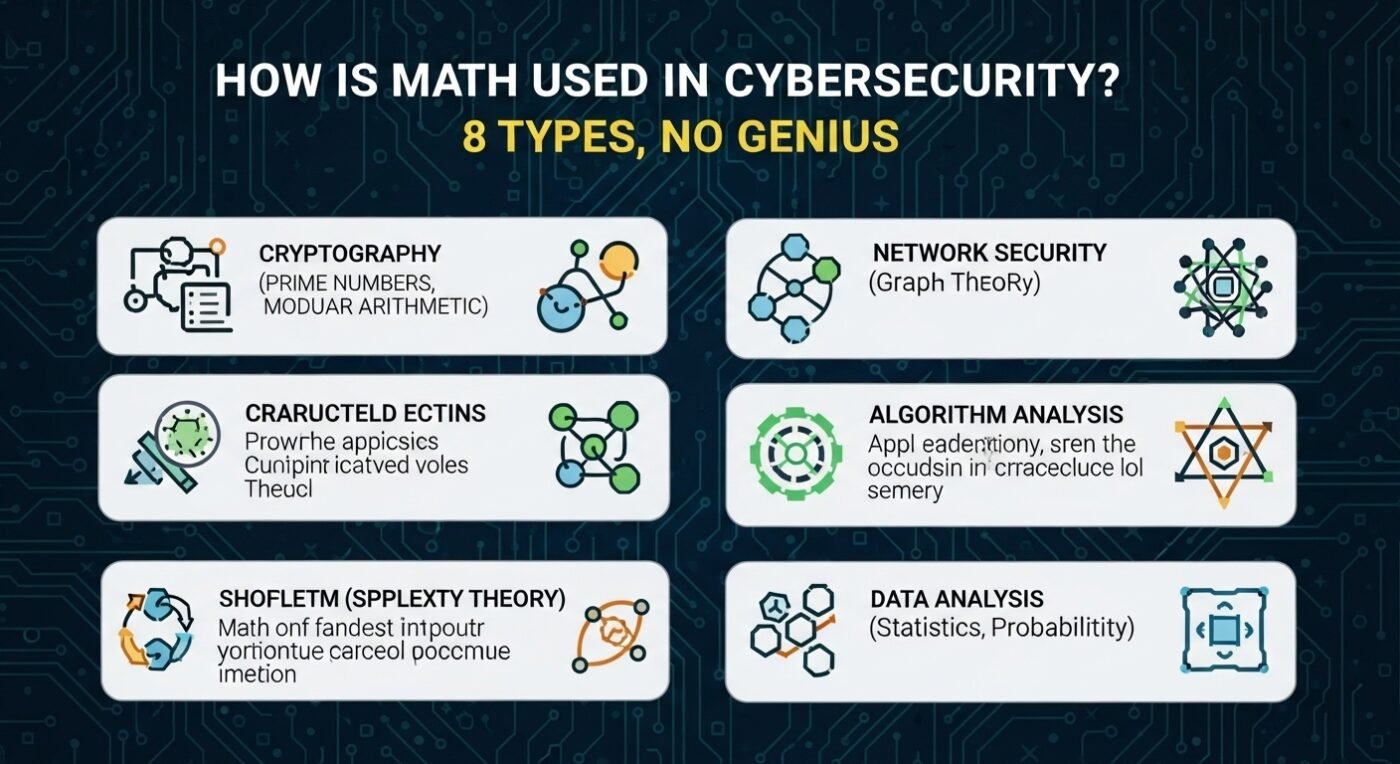
How is math used in cybersecurity? Math powers everything from encryption and cryptography to risk scoring, binary systems, and threat detection. While many people assume cybersecurity requires advanced mathematics, most roles only need basic algebra, logical thinking, and an understanding of how digital systems work.
That’s the short version. The longer answer is more useful, because the amount of math you’ll touch depends almost entirely on which role you’re aiming for. A SOC analyst and a cryptographer do very different jobs, and the math gap between them is enormous. This guide breaks down exactly how much math each path needs, the eight types that actually show up in the work, and what’s changing in 2026.
Does Cybersecurity Actually Require Math?
Here’s the honest truth from the field: day-to-day cybersecurity work is far less math-heavy than most beginners fear. Practitioners with decades of experience routinely say they’ve rarely used anything past high-school algebra. What matters far more is logical thinking — the ability to reason through a problem step by step.
Where math does appear, it’s usually applied rather than theoretical. You’re not deriving proofs; you’re reading a hexadecimal memory dump, interpreting a risk score, or understanding why an encryption scheme is hard to break. The concept matters more than the calculation, and tools handle most of the heavy lifting.
So if math has always been your weakest subject, that alone shouldn’t push you away from the field. The roles that demand serious math are a small slice of a very large industry.
How Much Math Does Each Cybersecurity Role Need?
This is the question behind the question, so let’s answer it directly. Math intensity varies sharply by specialisation:
| Role | Math intensity | What you’ll actually use |
|---|---|---|
| SOC Analyst / Incident Response | Low | Basic stats, logic, reading hex and binary |
| GRC / Compliance / Risk | Low–Medium | Probability, statistics, risk scoring |
| Security Engineer / Architect | Medium | Logic, networking math, some statistics |
| Penetration Tester / Ethical Hacker | Medium | Binary, hex, scripting logic, basic number theory |
| Security Data Scientist / ML | Medium–High | Linear algebra, probability, statistics, calculus |
| Cryptographer / Crypto Engineer | High | Number theory, modular arithmetic, linear algebra |
If your goal is an analyst, GRC, or engineering role — which is most cybersecurity jobs — you’re firmly in the low-to-medium band. Only cryptography and security data science sit at the deep end, and those are deliberately specialised paths you choose, not defaults you fall into.
The 8 Types of Math Used in Cybersecurity
When math does come up, here are the eight areas you’ll encounter, with what each is genuinely for.
1. Binary Math
Everything a computer does reduces to 0s and 1s. In cybersecurity you’ll read binary when analysing machine code, inspecting network packets, or working out how a buffer overflow corrupts memory. You rarely calculate in binary by hand — you read and interpret it. Understanding how data is represented at the bit level is what lets you spot when something has been tampered with.
2. Boolean Algebra
Boolean logic — AND, OR, NOT — is the backbone of decision-making in security. Firewall rules, intrusion-detection signatures, and SIEM query filters are all built on Boolean expressions. When you write a detection rule that fires “if source IP is external AND port is 22 AND login fails 5 times,” you’re doing Boolean algebra without thinking of it as math.
3. Hexadecimal Math
Hex (0–9 and A–F) is a compact way to represent long binary strings, and it’s everywhere: memory addresses, MAC addresses, malware hashes, and cryptographic keys. A malware analyst reading a hex dump needs to be fluent enough to recognise patterns and offsets. Again, it’s about reading and converting, not advanced computation.
4. Cryptography and Number Theory
This is where real math lives. Modern encryption like RSA relies on modular arithmetic and the difficulty of factoring large prime numbers — multiplying two huge primes is easy, but reversing it is computationally infeasible, and that asymmetry is what keeps your data safe. Most professionals only need to understand why this works; building the algorithms yourself is a specialist cryptographer’s job.
5. Linear Algebra
Vectors and matrices underpin a lot of modern security tooling — error-correcting codes, certain ciphers, and especially the machine-learning models now used for threat detection. If you move toward security data science, linear algebra stops being optional and becomes a daily tool.
6. Probability and Statistics
Risk is fundamentally probabilistic. Statistics power threat modelling, anomaly detection, fraud scoring, and the “likelihood × impact” calculations that drive every risk register. A GRC professional uses this thinking constantly — not with hard equations, but with a solid feel for probability. It’s arguably the most broadly useful math in the field.
7. Calculus
The one most beginners worry about is the one you’ll use least. Calculus shows up mainly in research, performance modelling of network traffic, and some advanced ML work. For the vast majority of cybersecurity roles, you can have a long, successful career without touching it.
8. Mathematical Logic and Algorithm Design
Formal logic is the connective tissue of the whole discipline. It underpins secure coding — and if you’re new to the field, getting comfortable with the fundamentals of computer programming is the natural first step — along with vulnerability analysis and the structured reasoning penetration testers use to chain exploits together. This “math” feels less like numbers and more like disciplined thinking — and it’s the single most transferable skill across every role above.
How Math in Cybersecurity Is Changing in 2026
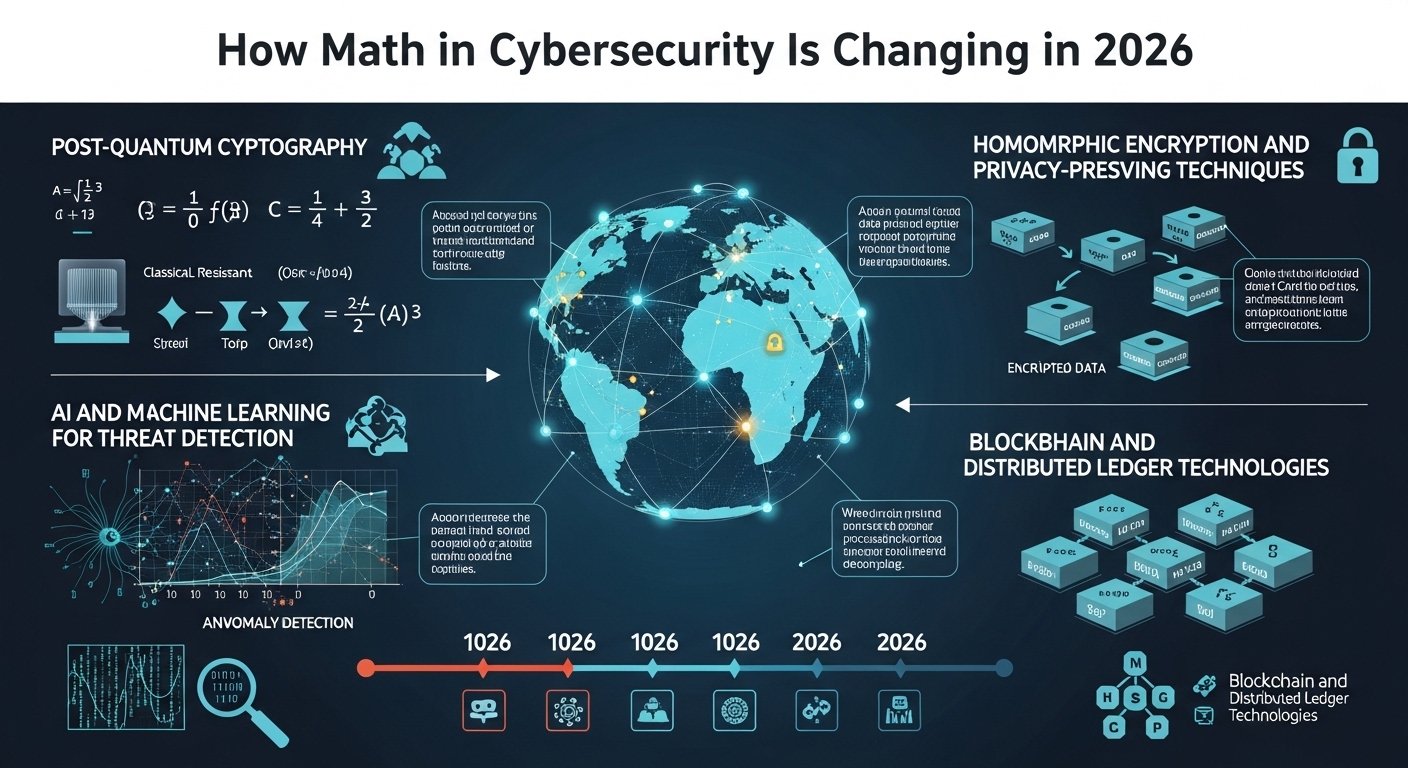
Two shifts are quietly raising the math bar in specific corners of the field.
First, AI and machine learning have moved from buzzword to standard tooling in threat detection and security operations — the same AI development techniques now reshaping every industry. That’s pushing more roles toward linear algebra and statistics, the foundations behind machine-learning models like classification and regression. Not for everyone, but anyone touching ML-driven security needs them.
Second, post-quantum cryptography is now a live concern. With quantum computing threatening today’s encryption, organisations are migrating to new quantum-resistant standards and retiring legacy and end-of-life systems, and that has renewed demand for number-theory expertise in crypto-focused roles. For most practitioners this means awareness, not calculation — but it’s worth knowing the ground is shifting.
Do You Need to Be Good at Math to Start?
No. What you genuinely need is comfort with logical problem-solving and a willingness to learn applied concepts as the job requires them. Many successful professionals came from non-technical backgrounds and picked up the relevant math on the way.
A practical path: start with the logic and binary fundamentals, build them through structured IT training, get hands-on with tools that do the calculation for you, and only deepen your math if you choose a specialised track like cryptography or security data science. Pursue the parts that match your goals rather than trying to master everything upfront.
If you’re weighing up where your strengths fit best, our team’s cybersecurity services page outlines the kinds of roles and skills real-world security work involves, and our 15 cybersecurity tips for small business guide shows how much of the work is practical rather than mathematical.
Frequently Asked Questions
Does cybersecurity require a lot of math? For most roles, no. Entry-level and analyst positions need only basic math and strong logic. Heavy math is limited to specialised fields like cryptography and security data science.
Can I get into cybersecurity if I’m bad at math? Yes. Logical thinking and problem-solving matter far more than mathematical ability, and tools handle most calculations. Plenty of professionals built careers without being strong at math.
What kind of math is used in cybersecurity? Mainly binary, Boolean algebra, hexadecimal, basic number theory, probability and statistics, with linear algebra and calculus reserved for advanced or research roles.
Does ethical hacking require math? Only lightly. Penetration testers rely on binary, hex, and scripting logic far more than advanced math. The core skill is structured, logical reasoning about how systems can fail.
What math should I learn first for a cybersecurity career? Start with binary, basic Boolean logic, and an intuitive grasp of probability and statistics. That foundation covers the majority of day-to-day cybersecurity work.
Is calculus required for cybersecurity?
No. Most cybersecurity professionals never use calculus in their daily work. Calculus is mainly relevant in advanced research, machine learning, and cryptography-focused roles.
Final Thoughts
So, how is math used in cybersecurity? Across eight areas — binary, Boolean algebra, hexadecimal, cryptography, linear algebra, probability and statistics, calculus, and logic — but the amount you’ll personally use depends on your role, and for most people it’s far less than they fear. The constant across every path isn’t math; it’s clear, logical thinking. Build that, learn the applied concepts your role demands, and you have everything you need to start a strong cybersecurity career.