

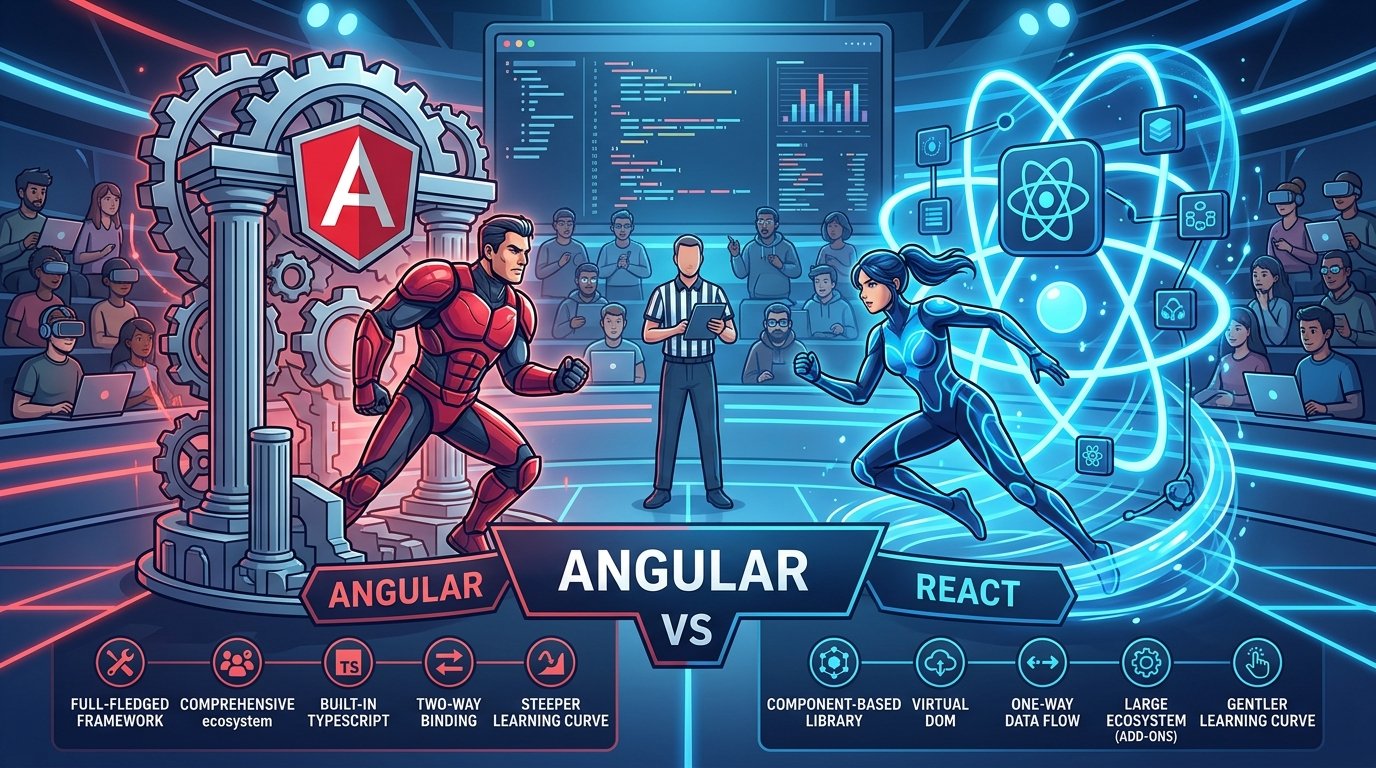
If you are planning a web application in 2026, the Angular vs React decision is probably the first technical fork in the road. Both technologies power millions of production applications. Both have massive corporate backing. And both have evolved so significantly over the past two years that advice from even late 2024 is already outdated.
So which one should you actually choose for your next project?
The answer depends less on which framework is “better” and more on what your business needs, what your team looks like, and how your product is expected to grow. This guide breaks down the Angular vs React comparison from a practical, business-first perspective — no abstract benchmarks divorced from reality, no tribal allegiance to either camp.
What Angular and React Actually Are (And Why the Distinction Matters)
Before comparing them, it is worth understanding a fundamental difference that shapes everything else.
React is a JavaScript library focused on the user interface layer. It was created by Meta (formerly Facebook) and open-sourced in 2013. React handles how your application renders and updates what the user sees, but it deliberately leaves decisions about routing, state management, form handling, and HTTP requests to third-party libraries or the developer’s own architecture. That flexibility is both its greatest strength and its steepest challenge. Understanding this distinction is especially important if your team is weighing web development versus app development priorities simultaneously.
Angular is a full-fledged framework built and maintained by Google. Written in TypeScript, it ships with an integrated solution for virtually every concern a web application encounters — routing, forms, dependency injection, HTTP communication, testing utilities, and internationalisation. You get an opinionated structure out of the box, which means less decision fatigue but also less flexibility.
The shorthand that has persisted since 2013 still holds in 2026: React is a library, Angular is a framework. That single distinction cascades through every architectural, hiring, and scaling decision your team will face. It is a similar kind of foundational choice to the Java vs Python debate — the right answer depends on what you are building.
React vs Angular Popularity in 2026: Where the Numbers Stand
Popularity does not determine which technology is right for your project, but it directly affects your hiring pool, community support, and long-term ecosystem health — all of which are business concerns.
React continues to dominate adoption metrics. According to the Stack Overflow Developer Survey, React holds roughly 44.7% developer usage compared to Angular’s 18.2%. The npm download gap is even wider — React pulls approximately 25 million weekly downloads while Angular sits around 3.5 million. React’s GitHub repository has accumulated over 230,000 stars, reflecting its enormous mindshare across the global developer community.
But raw popularity numbers only tell half the story. Angular powers some of the most demanding enterprise applications on the planet, including Google’s internal tooling and major financial platforms. Over 51,000 companies worldwide use Angular in production. In sectors like banking, healthcare, government, and insurance — where strict governance and long-term maintainability outweigh speed-to-market — Angular remains the dominant choice.
The react vs angular popularity debate, in practice, comes down to breadth versus depth. React is used more widely. Angular is used more deeply within the organisations that adopt it.
When to Choose React: Flexibility, Speed, and Ecosystem Depth
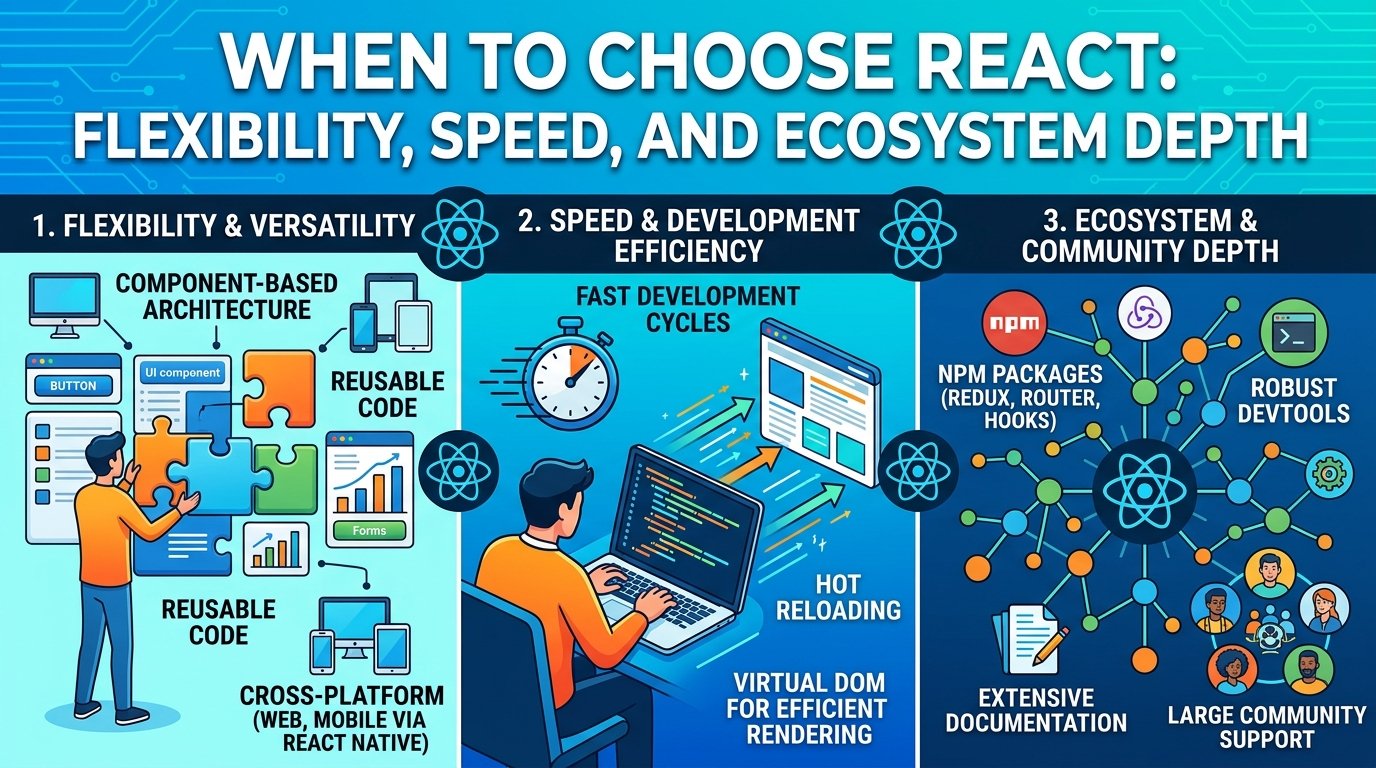
React makes the most sense when your priorities align with rapid iteration, interface-heavy products, and access to the largest possible talent pool.
Startups and product companies building consumer-facing applications tend to gravitate toward React for good reason. Its component-based architecture and one-way data binding produce fast, responsive interfaces. The Virtual DOM efficiently re-renders only the components that change, which translates into smooth performance for highly interactive applications like dashboards, social platforms, and real-time collaboration tools.
The ecosystem surrounding React in 2026 is unmatched. Next.js has become the default meta-framework for production React applications, providing server-side rendering, static generation, and API routes in a single package. State management has consolidated around mature options like Zustand and TanStack Query. And React Native extends the value of React skills into mobile development, letting teams share component logic between web and native applications.
For US-based businesses hiring frontend developers, React offers the widest talent pool. Job postings requiring React outnumber Angular postings by roughly two to one across major platforms. That translates into faster hiring cycles and more competitive candidate options. If you are also hiring for mobile, our breakdown of the skills needed for mobile app developers covers what to look for beyond framework knowledge.
React is the stronger choice when you need rapid prototyping, dynamic user interfaces, a large hiring pipeline, or cross-platform capability through React Native. If cross-platform is a priority, our comparison of native vs hybrid apps explores the trade-offs in more depth.
When to Choose Angular: Structure, Governance, and Enterprise Scale
Angular earns its place when the project demands strict consistency, long-term maintainability, and a framework that enforces discipline across large, distributed teams.
Enterprise organisations building internal tools, admin portals, or complex workflow systems benefit enormously from Angular’s opinionated architecture. When thirty developers across three time zones are contributing to the same codebase, Angular’s enforced patterns — modules, services, dependency injection, TypeScript by default — prevent the architectural drift that can plague large React projects where every team picks its own state manager, router, and folder structure.
Angular 20 and 21 have introduced signal-based reactivity and zoneless change detection, dramatically improving rendering performance and reducing bundle sizes compared to earlier versions. These updates represent the most significant modernisation Angular has undergone in years, closing the performance gap with React in many real-world scenarios.
Financial services companies, healthcare platforms, and government contractors in the United States frequently choose Angular for compliance-heavy applications. Platforms like financial risk management software benefit from Angular’s built-in tooling for form validation, internationalisation, and testing, which reduces the number of third-party dependencies — and in turn simplifies security audits and regulatory reviews.
Angular is the stronger choice when you need enforced code consistency, built-in solutions for complex forms and workflows, a single integrated toolchain, or a framework suited to long-lifecycle enterprise applications.
Real-World Use Cases Of Angular Vs React
The react vs angular 2026 decision often comes down to the type of product being built and the team building it.
A fintech startup launching a consumer-facing savings app with a small engineering team of five would likely choose React paired with Next.js. The flexibility, hiring speed, and ecosystem breadth align perfectly with a company optimising for velocity and iteration.
A Fortune 500 insurance company rebuilding its internal claims processing system — with forty developers, strict compliance requirements, and a planned ten-year lifecycle — would find Angular’s enforced structure and integrated tooling far more appropriate. The upfront learning curve pays for itself in reduced architectural fragmentation over time.
An e-commerce company planning both a web storefront and a mobile app might lean toward React for the added benefit of React Native code sharing, reducing the overall engineering investment across platforms. For teams still evaluating their storefront technology, our guide on whether your e-commerce platform is optimised for peak seasons covers the broader decision framework.
The pattern is consistent: React for product speed and flexibility, Angular for enterprise governance and scale. Neither is universally superior.
Performance in 2026: The Gap Has Narrowed
Performance comparisons between React and Angular have historically favoured React, but the landscape in 2026 is more nuanced.
React’s concurrent rendering features and the React Compiler (introduced in React 19) have improved rendering efficiency further, particularly for applications with complex, deeply nested component trees. Server Components allow parts of the UI to render on the server, reducing the JavaScript shipped to the browser.
Angular’s signal-based reactivity and zoneless change detection (arriving with Angular 20 and 21) represent a fundamental shift in how Angular manages DOM updates. Early benchmarks show meaningful improvements in Largest Contentful Paint scores, and the practical effect for new Angular applications is a noticeably leaner first-paint payload than the framework has ever delivered.
For the vast majority of business applications, both frameworks perform more than adequately. Performance should only be the deciding factor if your application involves unusually complex rendering requirements — real-time data visualisation, high-frequency UI updates, or extremely large datasets rendered in the browser. In those cases, a solid data architecture strategy matters just as much as the frontend framework you select.
Common Questions
What is the main difference between Angular and React?
React is a UI library that handles the view layer and lets developers choose their own tools for routing, state management, and other concerns. Angular is a complete framework that provides integrated solutions for all of those concerns out of the box. React offers more flexibility; Angular offers more structure.
Is React or Angular better for startups?
React is generally the better fit for startups. It has a lower learning curve, a larger talent pool for faster hiring, broader ecosystem support, and cross-platform mobile capability through React Native. Startups optimising for speed and iteration will find React’s flexibility advantageous.
Is Angular dying in 2026?
No. Angular has 3.5 million weekly npm downloads, over 51,000 companies using it globally, and active investment from Google. Angular 20 and 21 represent the most significant framework updates in years. Angular is not the most popular framework, but it is firmly established in the enterprise segment and is not declining.
Can I use React and Angular together?
Technically, yes — micro-frontend architectures allow different parts of an application to use different frameworks. In practice, most teams choose one to avoid the complexity and maintenance overhead of running both. The exception is large organisations with legacy Angular systems gradually introducing React for new modules — a pattern closely tied to broader software product modernisation strategies.
Which has more job opportunities: React or Angular?
React has approximately two to three times more job postings than Angular across major US hiring platforms. However, Angular roles tend to concentrate in enterprise organisations — finance, government, healthcare — where salaries are often competitive and the competition for each role is lower.
Should I learn React or Angular first?
If you want the broadest job market access and plan to work with startups or product companies, learn React first. If you are targeting enterprise roles in industries like financial services or government, Angular is a strong differentiator. The underlying concepts — component architecture, reactive state, TypeScript — transfer between the two.
Making the Right Choice for Your Business
The Angular vs React decision in 2026 is not about which framework is technically superior. It is about which one aligns with your team’s size, your product’s complexity, your hiring market, and your long-term maintenance expectations.
React remains the default recommendation for most web applications — especially consumer-facing products, startups, and teams that value flexibility and ecosystem breadth. Angular remains the right choice for large enterprise systems where enforced consistency, integrated tooling, and long-term governance outweigh the need for rapid experimentation.
If you are building a product and unsure which direction fits your business context, working with a development partner who has shipped production applications in both frameworks can save months of architectural missteps. The right framework decision made early prevents the expensive rewrite conversation two years later. And if AI capabilities are part of your product roadmap, our guide on how to build an AI app covers the full-stack considerations that sit alongside your frontend choice.
At Software System HQ, we help businesses across the US and globally make these architectural decisions with confidence — and then build the product to match. If you need a second opinion on your framework choice or a team to bring it to life, get in touch.