

Every successful business needs structure. Without clear systems, teams often depend on scattered spreadsheets, manual approvals, unclear responsibilities, disconnected software, and inconsistent decision-making.
That is why understanding what is a management system is important for any business that wants to grow, reduce risk, improve efficiency, and deliver consistent results.
A management system is not just a document, checklist, or software tool. It is the complete framework a business uses to manage its people, processes, policies, data, risks, and performance. It helps organizations move from reactive problem-solving to controlled, measurable, and scalable operations.
At Software System, we often see businesses struggle not because they lack talent, but because their internal systems are not organized enough to support growth. A strong management system solves that problem by giving every process a clear structure.
What Is a Management System?
A management system is a structured framework of policies, processes, procedures, responsibilities, records, tools, and performance measures used to help an organization achieve its goals consistently.
In simple words, a management system explains:
- What needs to be done
- Who is responsible for doing it
- How the work should be completed
- Which standards or rules must be followed
- How performance will be measured
- How problems will be corrected
- How the business will improve over time
For example, a company may have a process for handling customer complaints. Without a management system, complaints may be handled differently by each employee. With a management system, there is a clear workflow: receive the complaint, record it, assign responsibility, investigate the issue, respond to the customer, document the outcome, and prevent the same issue from happening again.
That structure creates consistency.
Management System vs Management Software
Many people confuse a management system with management software. They are related, but they are not the same thing.
| Management System | Management Software |
|---|---|
| A framework for managing business operations | A digital tool used to support that framework |
| Includes policies, people, processes, documents, and controls | Includes dashboards, forms, databases, automation, and reporting |
| Can be manual, digital, or hybrid | Usually cloud-based, web-based, or mobile-based |
| Defines how work should happen | Helps teams track and automate the work |
| Focuses on control, consistency, compliance, and improvement | Focuses on speed, visibility, and operational efficiency |
A business can have a management system without software, but as the company grows, manual systems usually become slow and difficult to control. That is where custom software, dashboards, workflow automation, CRM systems, asset tracking tools, and reporting platforms become valuable.
For companies that need a custom digital platform, web application development services can turn manual processes into scalable software systems.
Why Management Systems Matter for Modern Businesses
Modern businesses manage more complexity than ever before. Even small companies now deal with customer data, cybersecurity risks, online sales channels, remote teams, compliance requirements, cloud tools, marketing platforms, suppliers, payments, and customer support.
Without a structured system, problems multiply quickly.
A management system helps businesses:
- Improve operational efficiency
- Reduce repeated mistakes
- Maintain compliance
- Protect sensitive data
- Improve customer satisfaction
- Track performance
- Control risks
- Standardize team workflows
- Reduce dependency on individuals
- Scale without losing control
A growing business cannot depend only on memory, WhatsApp messages, Excel files, or informal instructions. Those methods may work in the beginning, but they become risky as operations expand.
A proper management system gives the business a repeatable way to operate.
Main Components of a Management System
A strong management system usually includes the following components:
| Component | Purpose |
| Policies | Define the rules and direction of the business |
| Procedures | Explain how tasks should be completed |
| Roles and responsibilities | Clarify who is accountable for each activity |
| Records and documentation | Prove that work was completed correctly |
| Risk controls | Reduce operational, financial, security, and compliance risks |
| Training | Ensure employees understand the system |
| KPIs and reporting | Measure whether the system is working |
| Internal audits | Find gaps before they become serious problems |
| Corrective actions | Fix problems and prevent them from repeating |
| Continuous improvement | Keep the system updated as the business grows |
These components work together. If one part is missing, the system becomes weak. For example, having procedures without employee training will not work. Having software without clear responsibilities will also create confusion.
Types of Management Systems
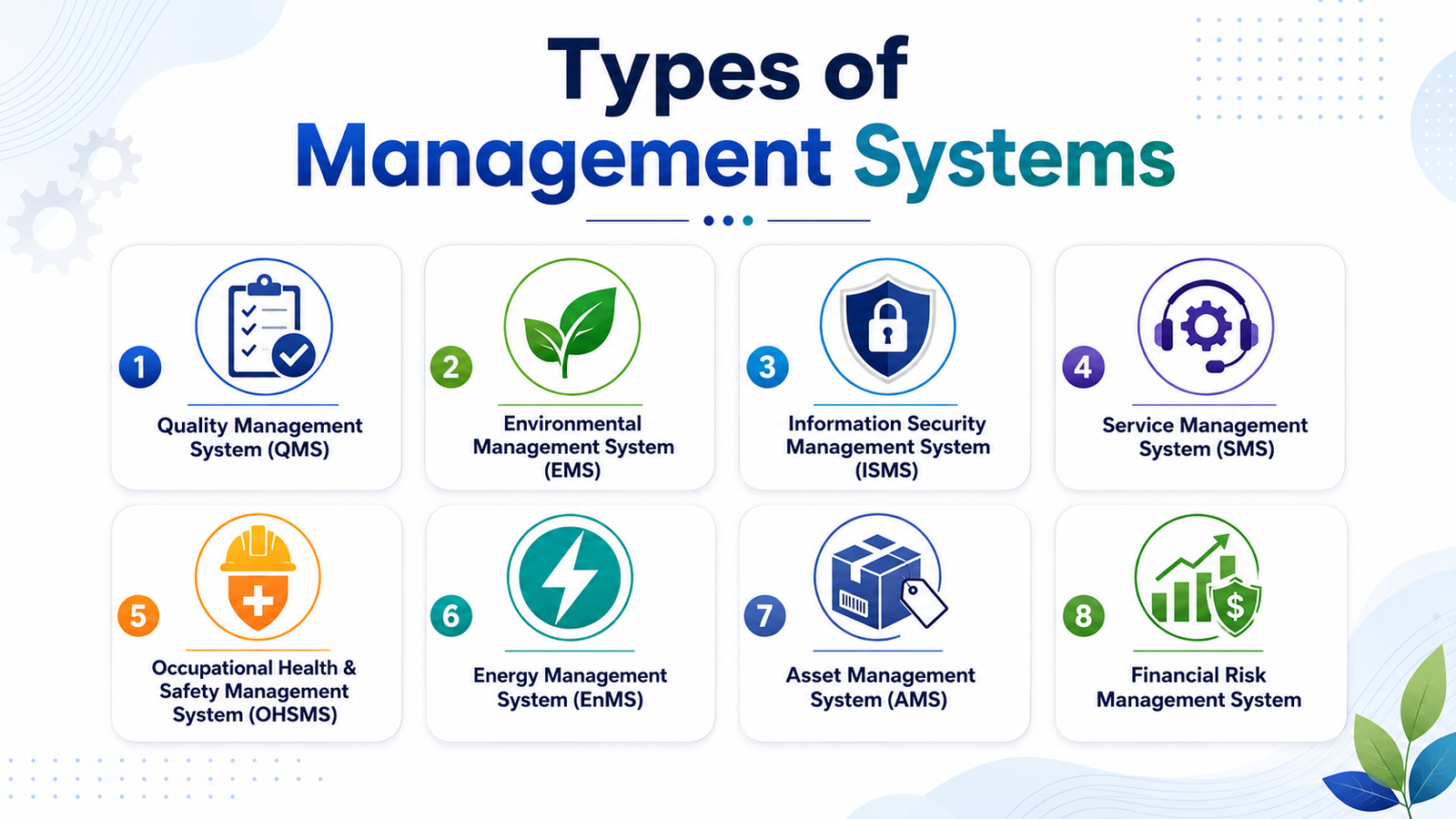
Different businesses need different types of management systems depending on their industry, goals, and risks.
1. Quality Management System
A Quality Management System, often called a QMS, helps a business maintain consistent product or service quality.
It is commonly used in manufacturing, healthcare, software development, construction, education, retail, and professional services.
A QMS helps businesses:
- Standardize workflows
- Reduce errors
- Improve customer satisfaction
- Control product or service quality
- Manage complaints
- Track corrective actions
- Improve operational consistency
For example, a software company may use a quality management system to define how code is reviewed, tested, approved, and deployed. An e-commerce business may use a QMS to check product quality, packaging accuracy, return handling, and customer complaints.
Quality management is not only about avoiding mistakes. It is about building a repeatable process that customers can trust.
2. Environmental Management System
An Environmental Management System, or EMS, helps businesses manage their environmental impact.
It is useful for companies that want to reduce waste, control energy use, manage emissions, improve sustainability, and follow environmental regulations.
An EMS may include:
- Waste management procedures
- Energy usage tracking
- Supplier sustainability checks
- Environmental risk assessments
- Recycling processes
- Compliance documentation
- Carbon reduction goals
For example, a logistics company may use an EMS to monitor fuel usage, vehicle emissions, route efficiency, and maintenance schedules. A manufacturing company may use it to reduce waste and improve resource efficiency.
Environmental systems are becoming more important as customers, governments, and business partners expect companies to operate responsibly.
3. Information Security Management System
An Information Security Management System, or ISMS, helps organizations protect data, systems, users, and digital infrastructure.
This is one of the most important management systems for modern businesses because almost every company now stores sensitive information digitally.
An ISMS helps businesses:
- Protect customer data
- Manage access control
- Reduce cyber threats
- Improve password and identity policies
- Monitor system vulnerabilities
- Prepare for incidents
- Maintain compliance
- Reduce the risk of data breaches
For smaller companies, information security may start with basic protections like strong passwords, employee training, backups, and secure devices. A good starting point is this guide on cybersecurity tips for small business.
Larger or high-risk businesses may need formal cyber risk assessments, security monitoring, and technical controls. In that case, professional cyber security services can help identify weaknesses and improve protection.
4. Service Management System
A Service Management System helps businesses deliver reliable services to customers or internal teams.
It is especially common in IT companies, SaaS businesses, support departments, telecom companies, digital agencies, and managed service providers.
A service management system may include:
- Support ticket workflows
- Service request handling
- Incident management
- Response time targets
- Escalation rules
- Customer communication templates
- Service reporting
- Knowledge base documentation
For example, an IT support company may define how customer issues are reported, prioritized, assigned, resolved, and reviewed. Without this system, support becomes inconsistent and slow.
Service management improves customer experience because every request follows a clear process.
5. Occupational Health and Safety Management System
An Occupational Health and Safety Management System helps businesses reduce workplace risks and protect employees.
It is important in industries such as construction, manufacturing, logistics, healthcare, warehousing, retail, and field services.
This system helps companies:
- Identify workplace hazards
- Record safety incidents
- Train employees
- Manage emergency procedures
- Reduce accidents
- Maintain compliance
- Improve employee wellbeing
For example, a construction company may use a safety management system to track site inspections, protective equipment, incident reports, worker training, and safety approvals.
Employee safety should never depend on informal instructions. It needs a documented and repeatable system.
6. Energy Management System
An Energy Management System helps businesses monitor and reduce energy use.
It is useful for companies with offices, factories, warehouses, data centers, retail stores, or large equipment.
An energy management system helps businesses:
- Track electricity and fuel usage
- Identify waste
- Reduce energy costs
- Improve sustainability
- Monitor equipment efficiency
- Set energy-saving targets
For example, a data center or manufacturing facility may use energy dashboards to identify high-usage periods and optimize equipment performance.
Energy management is not only an environmental issue. It is also a cost-control strategy.
7. Asset Management System
An Asset Management System helps businesses track and manage physical or digital assets.
Assets may include:
- Equipment
- Vehicles
- Laptops
- Mobile devices
- Inventory
- Tools
- Machinery
- Software licenses
- Cloud resources
- Office infrastructure
A good asset management system helps businesses know what they own, where it is, who is using it, when it needs maintenance, and when it should be replaced.
For example, a logistics company may track vehicles, maintenance dates, fuel costs, driver assignments, and repair history. A technology company may track laptops, software licenses, access permissions, and device security.
Businesses that need better control over physical or digital resources can explore custom asset management solutions.
8. Financial Risk Management System
A Financial Risk Management System helps organizations identify, measure, monitor, and reduce financial risks.
It is especially important for banks, fintech companies, insurance providers, investment platforms, lenders, and businesses handling sensitive financial data.
This type of system may manage:
- Credit risk
- Market risk
- Liquidity risk
- Fraud risk
- Regulatory reporting
- Audit records
- Transaction monitoring
- Risk scoring
- Compliance alerts
Financial businesses usually need more than spreadsheets because risk data must be accurate, secure, traceable, and available for decision-making. A deeper guide is available here: financial risk management software.
Real Examples of Management Systems by Industry
Management systems become easier to understand when you see how they work in real businesses.
Example 1: E-Commerce Business
An e-commerce business may need systems for:
- Product catalog management
- Inventory tracking
- Order processing
- Payment handling
- Customer support
- Returns and refunds
- Supplier coordination
- Website performance
- Marketing campaigns
- Data security
If the store runs on Shopify, the business may need custom workflows for inventory, customer experience, checkout, product pages, and app integrations. That is where Shopify development services can support the management system behind the store.
If the business is still deciding between platforms, this comparison of WooCommerce vs Shopify can help choose the right foundation.
Example 2: Finance or Banking Business
A finance business may need systems for:
- Customer verification
- Loan approvals
- Risk scoring
- Fraud detection
- Transaction monitoring
- Document control
- Audit logs
- Compliance reports
- User access control
In this industry, mistakes can create legal, financial, and reputational damage. That is why finance companies need strong workflows, secure software, and reliable reporting.
Example 3: Software Development Company
A software company may use management systems for:
- Project planning
- Requirement gathering
- Code review
- Testing
- Deployment
- Bug tracking
- Security checks
- Client communication
- Documentation
- Maintenance
Choosing the right technology also matters. For example, frontend decisions may affect long-term development speed and maintainability. This guide on Angular vs React explains how businesses can think about frontend framework choices for web applications.
Example 4: Small Business
A small business may not need a complex ISO-style system at the beginning. But it still needs structure.
A small business may start with:
- Customer inquiry process
- Sales follow-up system
- Invoice tracking
- Basic cybersecurity checklist
- Employee role documentation
- File naming rules
- Backup process
- Monthly performance review
As the business grows, these simple systems can later become automated workflows, dashboards, or custom software.
Benefits of a Management System
1. Better Productivity
A management system reduces confusion. Employees know what to do, how to do it, and who is responsible.
This saves time and reduces repetitive questions.
2. Stronger Compliance
Many industries must follow legal, security, safety, or operational requirements.
A management system helps keep records, policies, approvals, and audits organized.
3. Lower Risk
Businesses face many risks: cybersecurity threats, employee mistakes, financial losses, customer complaints, system downtime, supplier issues, and compliance failures.
A management system helps identify risks early and control them before they become serious.
4. Better Customer Experience
Customers notice consistency.
When service delivery, communication, quality checks, and support workflows are organized, customers receive a more reliable experience.
5. Easier Scaling
A business without systems depends too much on individual people. When those people leave or become overloaded, operations suffer.
A management system makes the business less dependent on memory and more dependent on repeatable processes.
6. Improved Decision-Making
Good systems produce good data.
When businesses track performance, complaints, costs, risks, and outcomes, leaders can make better decisions instead of guessing.
7. Better Accountability
A management system clearly defines roles and responsibilities.
This makes it easier to understand who owns each process, who approves each task, and who fixes problems when they happen.
How to Build a Management System
Building a management system does not mean creating hundreds of documents. The best systems are practical, clear, and easy to follow.
Step 1: Identify the Business Goal
Start by asking what the system needs to improve.
Examples:
- Better customer service
- Fewer mistakes
- Faster delivery
- Stronger cybersecurity
- Improved compliance
- Better asset tracking
- Lower costs
- More organized reporting
A management system should always connect to a real business goal.
Step 2: Map Current Processes
Document how work is currently done.
Look at:
- Who starts the process
- What information is needed
- Which tools are used
- Who approves the work
- Where delays happen
- Where mistakes happen
- What reports are required
This shows what needs to be improved.
Step 3: Define Roles and Responsibilities
Every important process needs an owner.
For example:
- Who handles customer complaints?
- Who approves refunds?
- Who updates website content?
- Who manages cybersecurity checks?
- Who reviews financial reports?
- Who maintains equipment records?
Clear ownership prevents confusion.
Step 4: Create Simple Procedures
Procedures should be easy to follow.
Avoid writing complicated documents that employees never use. A good procedure should explain the steps clearly and practically.
Use checklists, templates, screenshots, forms, and short instructions where possible.
Step 5: Choose the Right Tools
Some businesses can start with simple tools. Others need custom platforms.
Possible tools include:
- CRM systems
- Project management tools
- Asset tracking software
- Helpdesk software
- HR management systems
- Accounting software
- Custom dashboards
- AI automation tools
- Cloud databases
- Web applications
If a business needs intelligent automation, forecasting, or AI-powered workflows, AI development services can help turn manual operations into smarter systems.
Step 6: Connect Data and Reporting
A management system becomes more powerful when data is visible.
Useful reports may include:
- Sales performance
- Customer complaints
- Support response times
- Inventory levels
- Asset status
- Security incidents
- Employee tasks
- Compliance records
- Financial risks
Dashboards help leaders understand what is happening without waiting for manual updates.
Step 7: Train Employees
Even the best system fails if employees do not understand it.
Training should explain:
- Why the system matters
- How to use it
- What each person is responsible for
- What mistakes to avoid
- How to report problems
- How improvements will be made
Training should happen when the system launches and whenever major changes are made.
Step 8: Review and Improve
A management system is not a one-time project.
Businesses should review the system regularly and ask:
- Is the process still useful?
- Are employees following it?
- Are customers getting better service?
- Are errors decreasing?
- Are risks controlled?
- Are reports accurate?
- Does the software still support the business?
Continuous improvement is what keeps a management system useful over time.
Common Mistakes Businesses Make
Many companies implement management systems poorly. The most common mistakes include:
- Buying software before defining the process
- Creating too much documentation
- Making workflows too complicated
- Not training employees
- Ignoring cybersecurity
- Using disconnected tools
- Not assigning process owners
- Failing to review performance
- Treating compliance as a one-time task
- Not updating the system as the business grows
One of the biggest mistakes is thinking that software alone will fix operational problems. Software helps, but only when the business process is clear.
When Does a Business Need a Management System?
A business likely needs a stronger management system if:
- Employees are confused about responsibilities
- Tasks are delayed because approvals are unclear
- Customer complaints are increasing
- Important information is scattered across tools
- Reporting takes too much time
- Compliance records are hard to find
- The business depends too much on one person
- Cybersecurity risks are not being managed
- Inventory, assets, or financial records are disorganized
- Growth is creating operational stress
If these problems appear repeatedly, the business does not only need more effort. It needs a better system.
How Technology Improves Management Systems
Modern management systems are increasingly powered by digital tools.
Technology can improve management systems through:
- Workflow automation
- Real-time dashboards
- Cloud storage
- Mobile apps
- AI-based alerts
- Predictive reporting
- Customer portals
- Role-based access
- Data analytics
- API integrations
- Automated approvals
- Digital audit trails
For example, a manual asset register can become a real-time dashboard. A customer support spreadsheet can become a ticketing system. A compliance checklist can become an automated approval workflow.
For content-heavy or CMS-based businesses, a structured website also becomes part of the management system. Proper technical setup, indexing, schema, and site architecture matter for digital visibility. This technical SEO audit checklist explains how technical systems affect search performance.
How Software System Can Help
Software System helps businesses design, build, and improve digital systems that support real operations.
Depending on the business need, this may include:
- Custom web applications
- CRM portals
- Asset management platforms
- E-commerce systems
- AI-powered automation
- Cybersecurity improvements
- WordPress and Shopify development
- Reporting dashboards
- Workflow automation
- Business process modernization
For businesses using WordPress as part of their digital operations, WordPress development services can help improve performance, structure, scalability, and SEO readiness.
The goal is not just to build software. The goal is to create a system that helps the business operate better.
Frequently Asked Questions
What is a management system in simple terms?
A management system is a structured way of running a business. It defines the processes, responsibilities, tools, documents, and controls needed to achieve business goals consistently.
What are examples of management systems?
Common examples include quality management systems, environmental management systems, information security management systems, service management systems, safety management systems, energy management systems, asset management systems, and financial risk management systems.
Is a management system the same as software?
No. A management system is the full framework of people, processes, rules, and controls. Software is a tool that helps manage, automate, and track that system.
Why is a management system important?
A management system improves efficiency, reduces mistakes, supports compliance, controls risks, improves customer satisfaction, and helps businesses scale in a more organized way.
Do small businesses need management systems?
Yes. Small businesses may not need complex systems, but they still need clear processes for sales, customer service, finance, cybersecurity, employee tasks, and reporting.
What is the difference between QMS and ISMS?
A QMS focuses on quality management, while an ISMS focuses on information security. A QMS improves product or service consistency. An ISMS protects data, systems, and digital infrastructure.
Can a management system improve cybersecurity?
Yes. An information security management system helps businesses manage access control, employee security practices, data protection, incident response, backups, and cyber risk reduction.
How do you create a management system?
Start by identifying the business goal, mapping current processes, assigning responsibilities, documenting procedures, choosing the right tools, training employees, tracking KPIs, and reviewing the system regularly.
What type of management system does an e-commerce business need?
An e-commerce business may need systems for inventory, orders, payments, returns, customer support, supplier management, cybersecurity, website performance, and marketing workflows.
Should a business use custom software for its management system?
Custom software is useful when off-the-shelf tools cannot match the company’s workflow, reporting needs, security requirements, or integration requirements. It is especially useful for growing businesses with complex operations.
Conclusion
Understanding what a management system is helps businesses move from confusion to control.
A management system gives structure to daily operations. It defines how work is done, who is responsible, how performance is measured, how risks are controlled, and how the business improves over time.
Whether the focus is quality, cybersecurity, asset tracking, customer service, financial risk, e-commerce, or internal operations, the goal is the same: create a reliable system that supports long-term growth.
Modern businesses cannot rely only on scattered tools, manual processes, and informal communication. They need clear workflows, accurate data, trained teams, secure systems, and technology that supports the way they actually operate.
A strong management system is not just an operational improvement. It is a foundation for better decisions, better customer experiences, and sustainable business growth.