


Java and Python sit at the top of almost every programming language ranking, and they have held those spots for years. But saying they are both popular does not mean they are interchangeable. They were designed with different philosophies, attract different types of developers, and shine in completely different situations.
If you are trying to decide between Java and Python for a new project, a career move, or a team hiring decision, this guide walks through the real differences that actually matter in 2026.
What Makes Python and Java Fundamentally Different
Before diving into benchmarks and use cases, it helps to understand what separates these two languages at a conceptual level.
Java was created in the mid-1990s with the goal of writing code once and running it anywhere. It was designed around structure, strong typing, and reliability. Large organizations adopted it because it handled complexity well and scaled predictably across enterprise environments.
Python arrived earlier, in 1991, but gained mainstream traction much later. Its creator, Guido van Rossum, wanted a language that prioritized readability and simplicity above everything else. Python reads almost like plain English, and that deliberate design choice made it the default starting point for beginners and the preferred tool for data scientists.
Those founding philosophies still define how each language behaves today.
Syntax and Readability: Where Python Wins Clearly
The most visible difference between Java and Python is how the code looks on the screen.
A basic program that prints a line of text in Python looks like this:
print("Hello, World!")The same task in Java requires a class declaration, a main method, and explicit structure:
public class Main {
    public static void main(String[] args) {
        System.out.println("Hello, World!");
    }
}
That difference might look small, but it compounds across an entire codebase. Python developers write fewer lines to achieve the same outcome, which means faster prototyping, quicker iteration cycles, and less time spent reading boilerplate code.
For teams working on rapid development or early-stage products, this advantage matters. If your organization is thinking about software product modernization, Python often allows faster refactoring because the codebase stays leaner and more readable.
Java’s verbosity is not a flaw though. That explicit structure creates guardrails that prevent certain types of bugs, which becomes more valuable as projects grow in size and team members increase.
Speed and Execution Performance
This is where Java pulls ahead convincingly.
Java compiles code into bytecode that runs on the Java Virtual Machine. The JVM includes a Just-In-Time compiler that optimizes frequently executed code paths during runtime. The result is execution speeds that are consistently faster than Python for compute-heavy tasks.
Python is an interpreted language. The standard CPython interpreter processes code line by line, which adds overhead. In raw benchmark comparisons, Java typically runs two to ten times faster than Python depending on the task.
But raw speed is not the full picture.
Python’s most popular libraries for data processing, machine learning, and scientific computing are written in C or C++ under the hood. When a Python script calls NumPy or TensorFlow, the heavy computation happens in compiled code, not in the Python interpreter. That means the speed gap narrows dramatically in real-world data science and AI workloads.
If you are building financial systems, real-time trading platforms, or applications that demand sub-millisecond response times, Java is the stronger choice. For most other use cases, Python’s speed is more than adequate. If your project involves financial modelling specifically, understanding a solid data architecture strategy matters more than raw language speed in most cases.
Python’s Strengths in Practice
Python dominates several important areas of modern software development.
Data science and machine learning are where Python has no serious competition from Java. Libraries like Pandas, NumPy, Scikit-learn, and TensorFlow give data teams everything they need for analysis, visualization, model training, and deployment. If you are looking to build an AI application or explore how to build artificial intelligence systems, Python is the default starting point.
Web development is another area where Python performs well. Frameworks like Django and Flask let developers build production-ready web applications quickly. Django especially appeals to teams that want a batteries-included framework with built-in authentication, database management, and admin panels out of the box.
Automation and scripting remain one of Python’s most practical use cases. System administrators, DevOps engineers, and analysts regularly use Python to automate repetitive tasks, process files, schedule jobs, and glue different systems together.
Rapid prototyping is faster in Python because of its concise syntax and dynamic typing. When time-to-market matters more than raw performance, Python helps teams validate ideas quickly before committing to a more structured build.
The machine learning ecosystem also makes Python essential for understanding concepts like classification vs regression and working with AI comparison tools like DeepSeek V3 vs ChatGPT.
Java’s Strengths in Practice
Java excels in areas where stability, scalability, and long-term maintainability take priority.
Enterprise applications are Java’s traditional stronghold. Large organizations in banking, insurance, healthcare, and government rely on Java for systems that need to handle millions of transactions, run for years without major rewrites, and support thousands of concurrent users. The Spring Framework is the most widely used Java framework for enterprise development and remains one of the most mature ecosystems in all of software engineering.
Android mobile development has historically been Java’s territory. While Kotlin has become the preferred language for new Android projects, Java still powers a massive percentage of existing Android applications. Developers who understand Java can maintain, extend, and modernize those codebases effectively. If you are evaluating mobile technology choices, our comparison of Flutter vs React Native and guide on mobile app development skills cover the cross-platform side of that decision.
High-performance backend systems benefit from Java’s multi-threading capabilities. Java handles concurrent processing natively, which makes it ideal for applications that need to manage many simultaneous connections or compute-intensive operations.
Large team environments favour Java because its strict typing and explicit structure create natural consistency across codebases. When dozens or hundreds of developers work on the same project, Java’s rigidity helps prevent the kind of ambiguity that dynamic languages sometimes introduce.
For teams comparing broader technology decisions, our guide on web development vs app development explores how backend and frontend choices connect to overall project planning.
Career and Job Market Comparison
Both languages offer strong career prospects, but the demand profiles differ.
Python job listings have grown significantly over the past five years, driven heavily by the expansion of data science, machine learning, and AI roles. Companies hiring Python developers often work in analytics, automation, AI research, and startup environments.
Java job listings remain consistently high, especially in enterprise software, banking systems, government projects, and Android development. Java developers tend to find opportunities in larger, more established organizations where systems have long lifespans and reliability is non-negotiable.
Neither language is a bad career choice. But if you are deciding which to learn first, Python generally offers a gentler learning curve and faster path to building visible projects, while Java provides deeper exposure to software engineering concepts like strong typing, design patterns, and memory management.
Programming skills in either language also carry over well into specialized areas like computer programming in cybersecurity, where understanding code logic is fundamental to threat detection and prevention.
When to Choose Python for Your Project
Python is the right choice when your project involves:
- Machine learning, data analysis, or AI development
- Rapid prototyping where development speed outweighs runtime performance
- Automation scripts, internal tools, or system administration tasks
- Web applications using Django or Flask
- Small to medium teams that value code readability and fast onboarding
- Research and experimentation environments where iteration speed matters
If your business is exploring AI capabilities, our AI development services team works primarily with Python-based stacks for machine learning and intelligent automation projects.
When to Choose Java for Your Project
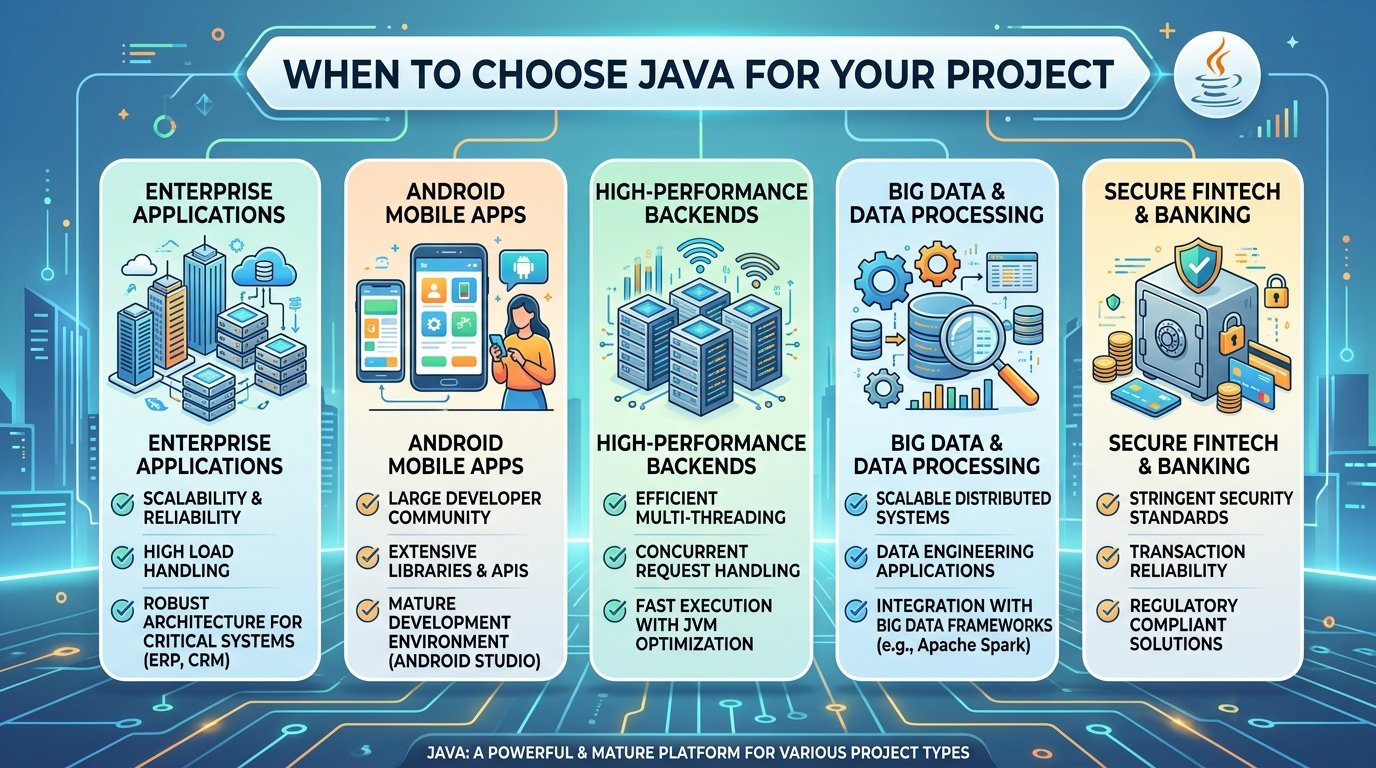
Java is the better fit when your project requires:
- Enterprise-grade stability and long-term maintainability
- High-throughput backend systems handling thousands of concurrent requests
- Android mobile applications or hybrid app backends
- Financial systems, healthcare platforms, or government applications
- Large development teams where code consistency is critical
- Systems that need robust multi-threading and memory management
For mobile-specific decisions, our mobile app development services page covers how we approach native and cross-platform builds depending on project requirements.
Can You Use Both Together?
Absolutely. Many modern technology stacks combine Java and Python within the same organization or even the same project.
A common pattern is using Java for the core backend services where performance and reliability matter most, and Python for data pipelines, analytics, machine learning models, and internal automation. The two languages communicate through APIs, message queues, or shared databases.
This hybrid approach lets teams use each language where it performs best instead of forcing one tool to handle everything. Organizations going through software product modernization often end up with this kind of mixed architecture as they update legacy systems incrementally rather than rewriting everything at once.
Quick Comparison Summary
Syntax: Python is concise and readable. Java is verbose but explicit.
Speed: Java is faster in raw execution. Python compensates with optimized libraries for data-heavy work.
Learning curve: Python is easier for beginners. Java teaches stronger software engineering fundamentals.
Best for AI and data: Python, by a wide margin.
Best for enterprise systems: Java, by a wide margin.
Mobile development: Java for native Android. Python is not a strong choice for mobile.
Web development: Both are strong. Python with Django or Flask. Java with Spring.
Job market: Both are in high demand. Python skews toward startups, AI, and data roles. Java skews toward enterprise and finance.
Community and libraries: Both have massive ecosystems. Python leads in data science libraries. Java leads in enterprise frameworks.
Final Thoughts
The Java vs Python debate does not have a single correct answer because the right choice depends entirely on what you are building, who is building it, and what constraints you are working within.
Python rewards speed, flexibility, and simplicity. It lets small teams move fast and gives data scientists the tools they need to work effectively. Java rewards structure, performance, and long-term thinking. It gives large organizations confidence that their systems will scale and remain maintainable for years.
The best developers eventually learn both, because understanding different paradigms makes you a stronger engineer regardless of which language you use day to day.
If you are evaluating technology choices for a new project and need guidance on the right stack, our team at Software System works across both ecosystems and can help you make the decision that fits your specific requirements.
Frequently Asked Questions
Is Python faster than Java? No. Java is faster in raw execution speed because it compiles to bytecode and runs on the JVM. However, Python can match Java’s practical speed in data science and AI workloads because its core libraries are written in optimized C code.
Which is better for beginners, Java or Python? Python is generally easier for beginners because its syntax is simpler and more readable. Java requires more boilerplate code but teaches important programming concepts like strong typing and object-oriented design from the start.
Can I use Python for mobile app development? Python has limited support for native mobile development. Java and Kotlin are better choices for Android, while Swift works best for iOS. For cross-platform options, frameworks like Flutter and React Native are more practical than Python.
Which language pays more in 2026? Both offer competitive salaries. Python developers in AI and machine learning roles often command higher salaries due to specialized demand. Java developers in enterprise and financial systems also earn strong compensation, especially in senior and architect-level positions.
Should I learn Java or Python first? If your goal is data science, AI, or rapid prototyping, start with Python. If your goal is enterprise software development, Android apps, or backend engineering, start with Java. Both are worth learning eventually.